 High-Power Forced Air Supply Fan — Brushless Turbo Technology. MistAirHome Direct Manufacturer.
Customer Service Hotline:
+8613261677119
High-Power Forced Air Supply Fan — Brushless Turbo Technology. MistAirHome Direct Manufacturer.+8613261677119
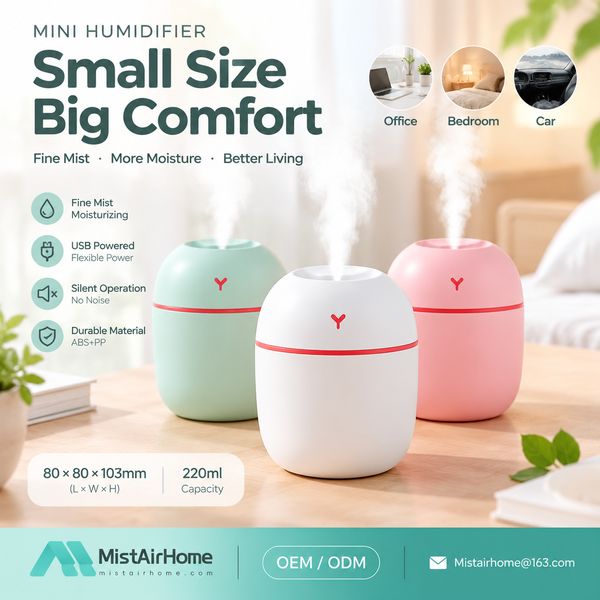
TL;DR - The Mistairhome WL-SH02M (STD) holds 215 mL and mists 44 mL per hour on the high mist step or 19.8 mL per hour on the low mist step, which is 4.9 hours of continuous running and 10.9 hours on the low mist step per fill; it covers 12 sq m (125 sq ft) at a 2.6 m ceiling, measures 23.3 dB at 1 m in operation, draws 2.0 W on the high step and runs from USB-C 5V/0.5A; the pack is 1200 mAh lithium polymer giving 4.2 hours per charge on the low mist step; it weighs 202 g and measures 6.8 x 6.8 x 11.4 cm, and ships documented to CE / RoHS / FCC standards for import into Malaysia. MOQ is 200 units per SKU with a 15-25 days lead time, FOB Shenzhen or EXW Longgang.
China Wanlin supplies the Small Humidifier for Small Room category as a direct manufacturer, not as a trading intermediary. The unit described below is one configuration out of 24 combinations (8 chassis x 3 SKU builds) that share a common misting family, a common tank and seal line and a common cell supplier, so a distributor can build a coherent shelf from one source rather than stitching together unrelated suppliers. Every unit referenced on this page corresponds to a specific bill of materials held on file, so the figures below can be reproduced or independently verified at sample stage.
Full specification of WL-SH02M-STD:
| Misting method | Ultrasonic piezo micro-disc at 2.4 MHz with a capillary feed |
| Tank capacity | 215 mL |
| Mist output, high step | 44 mL per hour on the high mist step |
| Mist output, low step | 19.8 mL per hour on the low mist step |
| Run time per fill, high step | 4.9 hours of continuous running |
| Run time per fill, low step | 10.9 hours on the low mist step |
| Coverage area | 12 sq m (125 sq ft) at a 2.6 m ceiling |
| Noise at 1 m | 23.3 dB at 1 m |
| Water type | Distilled recommended; the disc is fine-pitch and scales quickly on hard water |
| Battery pack | 1200 mAh lithium polymer |
| Cordless run time | Up to 4.2 hours per charge on the low mist step |
| Charge time | 3.4 hours from empty |
| Power input | USB-C 5V/0.5A |
| Rated power on the high step | 2.0 W |
| Control interface | Single button, two steps, auto shut-off at four hours |
| Night light | Single warm dot beside the outlet |
| Protection | Dry-run shut-off, sealed cap with a silicone valve for packing in a bag |
| Dimensions | 6.8 x 6.8 x 11.4 cm |
| Weight | 202 g |
| Warranty | 12 months |
Shipping configuration: Standard build, 1 x USB-C cable, 1 x cleaning brush, instruction leaflet, retail box. Master carton holds 60 units. Stated lead time is 15-25 days from order confirmation and deposit. Misting discs, wicks and cartridges are repeat line items and are ordered separately from the appliance.
Three things move this category in Malaysia: heated or cooled air that dries a room faster than people expect, buildings sealed tightly enough that nothing replaces the moisture, and a cleaning task that decides whether the product is still in use by March. Channel structure follows a stable pattern: importers take container volumes, regional distributors break bulk into pharmacy, hospitality and facilities supply, and online sellers absorb the mixed-SKU remainder that suits catalogue breadth.
For the Small Humidifier for Small Room segment the deciding specifications are mist output per hour, run time per fill, and what the unit does with dissolved minerals. Peak mist volume ranks well below all three, which surprises first-time buyers. This is why the table above states figures by model rather than by marketing tier: a buyer comparing two SKUs needs the output rate, the run time per fill and the water handling side by side, because those three predict both satisfaction and return rates better than any other set.
Wanlin serves Malaysia through three programmes that suit different balance sheets. New partners start with sample evaluation then a mixed trial order. Established distributors move to scheduled container shipments with locked pricing windows. Brand owners run private-label programmes with their own artwork and manuals. In all three cases the factory documentation, including the certificates and battery files listed further down this page, references the specific model code on the order rather than a generic family certificate, which is the most common cause of customs delay in this category.
Three engineering decisions separate this platform from the commodity end of the category. The first is how output is stated. We quote millilitres per hour, not adjectives, and we quote it for both steps. A buyer can divide that figure into the tank capacity and know how long a fill lasts before ordering a single unit, which is the arithmetic that decides whether a unit is practical in a bedroom or a nuisance in an office.
The second is what the unit does with dissolved minerals, and this is where the category is most often sold badly. An ultrasonic disc atomises water, and with it everything dissolved in that water, so on a hard supply the minerals become airborne and settle as a fine white film on whatever is nearby. Two answers exist, and we build both: a demineralisation cartridge in the tank, which is a consumable with a real working life, or an evaporative wick where the water never becomes airborne at all and the minerals stay behind in the wick. Neither is free, and the honest answer for a hard-water market is the evaporative build or the cartridge, not a cheaper unit and a complaint.
The third is the run time figure itself. A small appliance can only hold so much water, so the number that matters to an occupant is hours per fill at the step they will actually use. We publish both steps and we publish the tank size, because the two together tell a buyer whether a unit needs filling every night or every second night, and that single fact decides whether the product survives its first season in a household.
Every production batch is sampled for four things before release: mist output against the declared figure by weighed run, decibel reading at one metre in a semi-anechoic corner, pack capacity against the cell specification by discharge test where a cell is fitted, and dry-run shut-off function on an empty tank. Units falling outside tolerance are pulled before packing rather than after arrival, because a container of marginal units is a far more expensive problem at the destination than at the factory.
Operating requirement: A corridor or ceiling-mounted unit cannot reach a desk when the supply diffuser is moving air.
How the WL-SH02M answers it: One small unit per desk cluster sits inside the two-metre radius where the plume is still airborne, which is a placement answer rather than an output answer. The figures quoted in this scenario are drawn from the same specification set shown above, so the two cannot disagree.
Deployment: A post-operative recovery ward annexe with fourteen single rooms
Timing: 2025 July to September, winter with gas wall heaters in every room
Unflued gas heaters dry a room quickly and the nursing staff had been refusing to run them overnight for exactly that reason, which left patients cold. Fourteen WL-SH04Q units were placed on the bedside tables on the quiet build, because the nursing station audit had flagged night noise as the top complaint in the annexe the previous winter. The heaters went back on overnight, the humidifiers ran the low step until the morning shift, and the ward recorded no new complaints about dry air or noise for the rest of the season.
Deployment: A dental practice with four surgeries and a sterilisation room
Timing: 2025 December to February, mild but with air conditioning running for cooling in the afternoon
Athens is mild, which is why the practice did not expect a humidity problem, and the cause turned out to be cooling rather than heating: the units ran for comfort in the afternoon and removed water from the surgeries. Six WL-SH01U units went onto the countertops with cartridges, because Athens water is hard and the practice had already had one ultrasonic unit leave dust on a dark cabinet. The staff's own marker was that the sterilisation log book, whose pages had been curling at the corner, stopped doing so.
Deployment: A 40-bed nursing home with a winter smog period and sealed windows
Timing: 2025 November to February, dry winter with particulate alerts and very low humidity
Delhi combines a dry winter with an air quality problem, so windows stay shut and the air gets drier. The nursing home took 20 WL-SH03E evaporative units, specifically because an ultrasonic unit in a room with high particulate load can carry minerals into the air, and the medical staff asked for a wick type on that basis. The humidistat target of 45 percent was set once and never changed, and the nursing home recorded fewer complaints of dry throat among staff on night duty.
Across these deployments the pattern is consistent. Buyers who specify from measurements rather than superlatives end up with fewer returns, and the three measurements that matter are mist output per hour, run time per fill at the step people actually use, and what the unit does with dissolved minerals. Everything else, including how a unit looks in photographs, affects the first order only.
The same misting family is specified into four quite different duties, and the differences are worth stating plainly because they decide which model a buyer should stock rather than which one photographs best.
| Scenario | Setting | Operating requirement |
| SC05-PLANTS | Indoor plant shelves, seedling trays and terrariums under a grow light | Leaves mark where hard water dries on them, and a fixed plume wets one spot and starves the rest. |
| SC08-STUDY | Shared study bedrooms and student residences with thin partition walls | A unit that can be heard from the next bed is a unit that gets unplugged by the end of the week. |
| SC01-BEDROOM | Main bedroom overnight with the heating or heat pump running | Whatever sits on the nightstand has to be inaudible and dark for eight hours. |
| SC04-VEHICLE | Long-haul truck cabs and delivery vans on a full working day | Bumps spill an open tank, and nothing should need attention at speed. |
Two consequences follow for a distributor. First, a range built around one misting family and three SKU builds covers more duty than a range built around three unrelated models, because the tank, seal and disc line is shared. Second, the consumable is where the margin sits after the first season: discs, wicks and cartridges repeat, while the appliance itself does not.
Working factory direct changes four things that a distributor notices. Specification is fixed at the bill of materials rather than at the catalogue, so a quoted output rate, run time or decibel figure is the figure the container ships with, not a figure that drifts between batches. Documentation is issued per model code, which removes the generic family certificate problem that holds shipments at customs.
Third, the disc and wick supply is controlled. A misting appliance stands or falls on consistency between units, and discs bought per batch from whichever factory quoted lowest is the single most common cause of a second shipment performing differently from the first. We build the disc, we publish its drive frequency, and the output figure on the specification table is a weighed-run figure rather than a nominal one.
Fourth, changes are possible without a new supplier search. Housing colour, panel insert, packaging artwork, manual language and the accessory kit are all handled inside the existing tooling for most models in this range. Buyers who start with a standard build and move to private label in the second season do not restart the engineering conversation, and they do not have to re-qualify the water compatibility question either.
None of this removes the need for the buyer to test. We send samples on the same production specification as the bulk order, and we would rather a buyer measure a sample and find a limitation early than place a container against a claim they have not checked.
Documentation is issued against the model code on the order. The standard set covers CE / RoHS / FCC / UKCA / REACH / EMC / PSE / KC / RCM / UN38.3 / IEC 62133, with the battery reports included because any rechargeable appliance cannot be booked onto a vessel or an aircraft without them. Where a buyer's own regulator asks about the water path, the material declaration covers every wetted part, which is what a household appliance submission usually asks for.
Three points matter for import planning into Malaysia. The safety report is issued to IEC 60335-1 as a household appliance, not as a piece of electronics, because that is how the product is classified at customs in most markets. The radio documentation applies only to models with a humidity sensor or a connectivity section and is issued separately, so a distributor stocking only the manual models does not carry that requirement. And the battery file belongs to the cell part number, so it stays valid across colour and packaging revisions but needs re-issuing if the cell specification itself changes, which we do not do silently.
Water quality is worth planning rather than discovering. A market on hard municipal water needs the demineralisation cartridge in the box or the evaporative build on the shelf, and which one is a commercial decision the distributor makes once rather than a complaint they handle per unit. We state the position by model rather than leaving it to the listing copy.
The landed cost model for this category has three lines, and only the first is obvious. The appliance is line one. The consumable line is line two - cartridges, wicks and replacement discs - and unlike most small appliances it is the line that recurs, which is the commercial reason this category is worth importing rather than merely trading. Freight is line three, and it behaves better here than in most small-appliance categories: these units cube out rather than weigh out, so a container fills on volume long before it hits a weight limit.
Consumable planning is where first-season distributors most often get it wrong. Ordering nothing beyond the appliance leaves the installed base without cartridges precisely when the habit has formed, and the buyer then fills the gap with another supplier's consumable, which may not fit the tank neck. We suggest taking discs, wicks and cartridges on the first order, then scheduling a reorder against the installed base.
The unit specified on this page ships with standard build, 1 x usb-c cable, 1 x cleaning brush, instruction leaflet, retail box. Master carton quantity is 60 units, which is the figure that sets the freight quote. Buyers consolidating several models into one container should send the model mix before quoting, because carton quantities differ between chassis and the container plan changes accordingly.
On pricing: we quote FOB Shenzhen or EXW Longgang against a stated quantity and SKU mix. We do not quote a single unit price that silently assumes the highest-volume configuration, and we state the validity window on the proforma rather than leaving it open.
Question 1: What is the minimum order quantity for a first small humidifier order?
Answer: MOQ is 200 units per SKU for standard builds and 300 units for custom colour or private-label packaging. Mixed-container orders combining several models are accepted as long as each individual SKU clears its own minimum. The specification table on this page shows the exact build we ship for each SKU suffix.
Question 2: How is coverage area stated, and how should a buyer interpret it?
Answer: We quote area against a stated ceiling height of 2.6 m and against a still room, and we publish the mist output per hour behind the figure so a buyer can check it rather than take it on trust. Two corrections matter in practice. First, a room with a high ceiling holds proportionally more air, so a Berlin apartment with 3.4 m ceilings will run a unit dry faster than the floor area suggests. Second, mechanical ventilation removes mist, so one unit in a corridor does not humidify the rooms off it; one unit per occupied room does. A buyer can verify any of this with a hygrometer and twenty minutes.
Question 3: Does this humidifier leave white mineral dust on furniture?
Answer: It depends on the water and on the misting method, and this is the single largest cause of returns in the category. An ultrasonic disc throws everything dissolved in the water into the air, so on a hard supply it leaves a fine white mineral film on dark surfaces within days. Two answers exist: a demineralisation cartridge in the tank, which is a consumable with a real working life, or an evaporative build where the water never becomes airborne and the minerals stay in the wick. We say which markets need which, because selling an ultrasonic unit into a hard-water city without the cartridge is how a distributor earns a return rate rather than a reorder.
Question 4: Which compliance files ship with a small humidifier order?
Answer: The standard file set is the CE technical file, RoHS and REACH declarations, an EMC test report, the IEC 60335-1 household appliance safety report, and for battery builds a UN38.3 test report with an IEC 62133 cell report and MSDS. For North America we add FCC documentation for the digitally controlled models. For Japan and Korea we issue against PSE and KC, and for Australia and New Zealand against RCM, in each case against the model code on the order rather than a generic family certificate. Where a buyer's own regulator asks about materials in the water path, we supply a declaration covering every wetted part.
Question 5: Can we sell these under our own brand, with our own packaging?
Answer: Yes. Private label covers housing colour, logo placement, retail artwork, manual language and the accessory kit, and most of it sits inside existing tooling for this range, so customisation does not mean re-engineering. What we ask buyers to decide early is which consumables travel with the appliance: a unit sold without a cartridge in a hard-water market generates complaints that no amount of artwork will fix, and adding the cartridge to the first order costs less than the returns it prevents.
Question 6: How often does the unit need cleaning, and what does that involve?
Answer: More often than most buyers expect, and this is the part of the ownership story that decides whether the product is still in use in March. A tank holding standing water at room temperature grows biofilm, so the honest interval is every five to seven days in continuous use, with a full dry-out if the unit will stand unused. This is why we specify a wide tank opening on the larger models: a tank a hand cannot reach into is a tank that never gets cleaned properly. The wick and cartridge are consumables with a published working life and are ordered separately from the appliance.
Question 7: What warranty and spares support do you provide?
Answer: Twelve to twenty-four months depending on the model, against manufacturing defect. Misting discs, wicks, cartridges, seals and batteries are stocked as separate line items and can ride in the same container as the units, which is the cheapest way to buy them. A misting disc is a wearing part with a service life measured in months of continuous use rather than years, and hard water shortens that considerably, so we suggest first-time buyers take one spare disc per twenty units and one cartridge per unit where the water is hard. A distributor who cannot supply a consumable loses the next appliance order along with the goodwill.
Question 8: How long does sampling and first production take?
Answer: Samples ship in 5 to 7 working days from an existing specification, or 15 to 20 days if a custom colour is required. First production runs in 15 to 35 days depending on SKU and quantity, measured from order confirmation and deposit, with the exact figure stated on the proforma invoice rather than left open. Battery shipments add a documentation step at booking, which we handle but which needs a few extra days on the freight side.
Where an answer above depends on the buyer's market, the hardness of the local water or the ceiling height in the target room, the honest answer is that it depends, and we would rather say so than publish a figure the buyer cannot reproduce. Buyers comparing quotes should check whether a rival's coverage area states a ceiling height and whether the mist output is given per hour.
Four kinds of partner do well with this range. Importers with existing small-appliance or pharmacy distribution take container volumes and service the retail channel. Regional distributors buy mixed pallets and cover hospitality, clinical and facilities accounts, which is where the repeat consumable order is generated.
Online and cross-border sellers take mixed SKUs and work the long tail, where a specific phrasing such as an in-car or improved-sleep listing converts better than a generic humidifier listing. And pharmacy chains and home fragrance houses run private label, usually entering with one model and expanding once their own consumable sales justify it.
What all four need from the factory is the same thing: a specification that does not drift, documentation that matches the model code, and a misting disc that stays on the same drive frequency after the first season. That is the whole of the offer, and it is worth more than a lower unit price that comes with none of it.
Wanlin is a manufacturer and export supplier of small humidifier appliances, not a trading intermediary, and we are open to working with local partners, distributors and export traders in Malaysia on any of the four routes above.
A first order is structured in three steps rather than one leap. Step one is sample evaluation: one or two units on the specification the buyer intends to import, shipped in 5 to 7 working days, measured by the buyer against whatever standard they intend to be held to by their own customers. For this category that means a weighed run to confirm the output per hour, and a fill-to-empty timing to confirm the run time at the step they will actually use.
Step two is a mixed trial order, typically 200 to 600 units across two or three models, which tests the channel without committing to a full container on unproven models. Step three is scheduled container shipments with a locked pricing window and a consumable plan attached.
Customisation enters at whichever step the buyer wants it. Colour and packaging can be done at trial quantity; manual translation and accessory kit changes are usually worth doing only once volume justifies the setup. We state the setup cost and the unit cost separately so the buyer can see what the customisation actually costs at their quantity.
The WL-SH02M (STD) is one configuration out of 24 in this range. The right way to evaluate it is to order a sample on this specification and measure it: mist output by a weighed run, run time per fill at the low step, and noise at one metre in a quiet room.
We publish figures that a buyer can reproduce, we state the ceiling height behind the coverage number, and we say plainly where the honest answer depends on the room or the water. That is a narrower claim than some competitors make, and it is the one we can stand behind at sample stage.
Export enquiries are welcome from distributors, brand owners, pharmacy and home fragrance groups, cross-border sellers and export traders. Samples, specification sheets and the certification and battery files are available on request.
Published by: Wanlin Manufacturing Group, MistAirHome Export Division
Published on: September 23, 2026
Data sources: in-house factory testing + misting disc and cell specifications + certification and battery files + partner deployment records
Company address: Wanlin Group, Building B, Building 1, Beisida Medical Device Building, 28 Nantong Avenue, Baolong Community, Baolong Sub-district, Longgang District, Shenzhen, Guangdong, China
References: factory quality manual + third-party test reports + customer shipment records
Contact: Mistairhome@163.com / +8613261677119 / https://www.mistairhome.com